
| Japan | |
|
|
Iwakuni, Japan 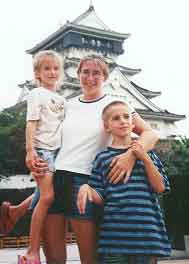 My daughter, Alisa, is a LCDR and
Flight Surgeon in the U.S. Navy stationed at the Iwakuni Marine Air Base
in Iwakuni, Japan with her husband, Richard, and their two children, Nick,
age 10, and Allie, age 6. When this couple realized they would be
stationed in Japan, Richard began studying Japanese so they could get
around and enjoy their tour of duty more. Upon arriving in Japan,
they placed their daughter in a Japanese nursery school so that she, too,
could learn the language. When we arrived for a four-week visit,
they had been there for about fourteen months and had settled in very
nicely. We stayed with them on base, and the letters that follow were
sent to friends back home in the states. My daughter, Alisa, is a LCDR and
Flight Surgeon in the U.S. Navy stationed at the Iwakuni Marine Air Base
in Iwakuni, Japan with her husband, Richard, and their two children, Nick,
age 10, and Allie, age 6. When this couple realized they would be
stationed in Japan, Richard began studying Japanese so they could get
around and enjoy their tour of duty more. Upon arriving in Japan,
they placed their daughter in a Japanese nursery school so that she, too,
could learn the language. When we arrived for a four-week visit,
they had been there for about fourteen months and had settled in very
nicely. We stayed with them on base, and the letters that follow were
sent to friends back home in the states.
Japan - Part I The food here is to die for. I'm writing down my favorite dishes so I can try to find them when we get home. We have averaged one meal "out" a day since arriving. One of the fun aspects of our stay here is that Rich has been studying
the language since arriving, thereby giving us wonderful
opportunities to interact with the locals. Furthermore, he is able
to read the language. Frankly, I think he should hire himself out as a
tour guide while he is here. He
is excellent! It makes our visit quite meaningful.
Japan - Part 2 I have to admit, I have felt much apprehension in coming to this country. Under the circumstances of the WWII war years, I felt we were right to drop the A Bomb, and I still do. I am glad, however, the decision to drop the bomb was not mine to make, for the suffering we inflicted on these people is beyond comprehension. A visit to Hiroshima has not been on MY list of things to do, for reasons of hypocrisy, fear of guilt, and not wanting to feel apologetic toward people who, most certainly, must hate us for the atrocity we committed.
There was a charming moment as we were about to cross the bridge over
the river in route to the museum. We were being overtaken by a class of
elementary school students. Richard turned around and said "ohiogazimas"
and the children broke into delighted smiles and laughter and returned
"good morning" back at us. We continued to say "ohiogazimas"
until all of them had gone by. We went through the museum and saw two replicas of the area bombed, before and after, and the history leading up to the bomb. Then we went through the section containing the evidence: melted glass bottles, burned clothing of children, a bike, a tricycle, a broken Buddha, etc. And then there were the skin and fingernails of a young boy saved by a mother to show the out-of-town father when he returned after the boy died -- all pretty grim. Not every American can hold themselves together while going through these rooms, but I was able to hang tough. I must admit it was pretty depressing. So, we were just about to leave the building and this teen-age boy came up to me, and in halting and embarrassed English he wanted to know how I felt about all this! Holy Moley! How could I put it into words? "Terrible" I said. And we talked for about ten minutes. I hope I was able to answer him with compassion and truth. And, no, I didn't use the words, "your war lords started it." I did, however, in the end, I DID direct the conversation toward world peace and environmental concerns and the oneness of all people. In the end, I think trumpets blew and the angels sang. I don't know for sure, but I certainly hope so. It took guts for that kid to ask the question. He deserved an honest answer. I sure hope he understood. Japan - Part 3 - Konnichiwa (hello): While Alisa has been island hopping in the Pacific this past year, Richard has been busy doing the Richard thing--attracting people. And the people he attracts, both American and Japanese, are a delightful, fun-filled lot. It does not surprise me that he has brought his family into a sort of cultural exchange with two other Japanese families.
Half the audience sat on a ground tarp in front of the stage and the rest stood around the perimeter in front of the concession stands where you could purchase food at any time during the performance if you become hungry. You didn't have to wait for the end of an act to eat. At one point, they interrupted the story-dancing with some comic relief, after which they threw rice cakes into the audience. Although we didn't catch any, our Japanese friends collected four little bags for us out-of-towners to take home. They were terrible. We learned later, we should not have micro waved them. We left after about three hours and the performance ran another hour and a half. I wish we could have seen it all. Back at a Japanese home, we had tea and treats and chatted for another hour.
Our hostess, one of Rich's students, served us "snacks" which
turned out to be a complete Continued on: |
 Rich, our son-in-law, tells me that the Japanese people are totally
non-judgmental and very generous. This was proven the other day
while at a restaurant in town. We had Allie with us and she was
being her usual free-spirited self, singing and dancing between the
tables, lying in her chair with her feet level with the table
(before food arrived, of course) -- definitely a horror to Emily Post
advocates. But when we got ready to leave, the elderly
grandmother/owner, regal in appearance and demeanor, had the waiter
bring Allie two gorgeous origami swans, one of which was larger than
your fist. I would have paid $5.00 to $l5.00 for them at a craft
show. Of course Allie always charms and enchants them with her
accent-free Japanese, and she IS cute.
Rich, our son-in-law, tells me that the Japanese people are totally
non-judgmental and very generous. This was proven the other day
while at a restaurant in town. We had Allie with us and she was
being her usual free-spirited self, singing and dancing between the
tables, lying in her chair with her feet level with the table
(before food arrived, of course) -- definitely a horror to Emily Post
advocates. But when we got ready to leave, the elderly
grandmother/owner, regal in appearance and demeanor, had the waiter
bring Allie two gorgeous origami swans, one of which was larger than
your fist. I would have paid $5.00 to $l5.00 for them at a craft
show. Of course Allie always charms and enchants them with her
accent-free Japanese, and she IS cute.
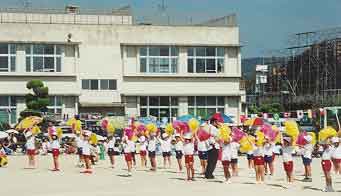 Elementary and pre-schoolers and their families gathered in town at a
large baseball-sized field to participate and watch the activities.
Children from the school on base were there, too. All the children wore their
school sports uniforms. The opening ceremonies were so beautiful, I had to
blink back tears. Parents brought folding chairs, tables, umbrellas and
lunch.
Elementary and pre-schoolers and their families gathered in town at a
large baseball-sized field to participate and watch the activities.
Children from the school on base were there, too. All the children wore their
school sports uniforms. The opening ceremonies were so beautiful, I had to
blink back tears. Parents brought folding chairs, tables, umbrellas and
lunch. 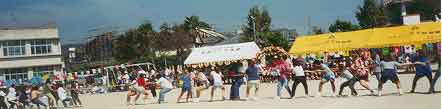
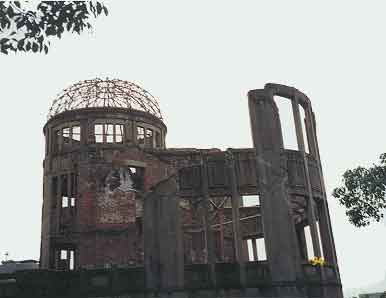 Having said all that...Richard proceeded to take me and Bob to
Hiroshima, to the Genbaku Dome at the Peace Memorial Park, and to the
museum. Richard, my wonderful son-in-law, is truly a remarkable man, wise
beyond his years, for it was a healing. I have not changed my views, but I
have put it to rest. Rich has said that most people understand and do not
hate us. How they feel toward their war lords and ours could be a
different story, however. They are using their experience to take the
opportunity, to try to lead the world to realize we MUST have world
peace. They know all about war. They have been there, done that.
Having said all that...Richard proceeded to take me and Bob to
Hiroshima, to the Genbaku Dome at the Peace Memorial Park, and to the
museum. Richard, my wonderful son-in-law, is truly a remarkable man, wise
beyond his years, for it was a healing. I have not changed my views, but I
have put it to rest. Rich has said that most people understand and do not
hate us. How they feel toward their war lords and ours could be a
different story, however. They are using their experience to take the
opportunity, to try to lead the world to realize we MUST have world
peace. They know all about war. They have been there, done that.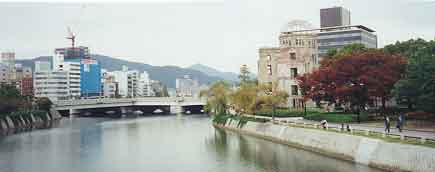
 As a result, Saturday night, we were invited to attend a performance of
Kagura, or Temple Dancing. Frankly, I thought we were watching Kabuki,
but no, it was Kagura, which may be likened to "light opera" and
Kabuki, which could be compared to "grand opera" -- Japanese
style, of course. Drums and flute accompanied the performance, and the
costumes, some of which probably weighed forty pounds and had massive gold
embroidery, must have cost a fortune.
As a result, Saturday night, we were invited to attend a performance of
Kagura, or Temple Dancing. Frankly, I thought we were watching Kabuki,
but no, it was Kagura, which may be likened to "light opera" and
Kabuki, which could be compared to "grand opera" -- Japanese
style, of course. Drums and flute accompanied the performance, and the
costumes, some of which probably weighed forty pounds and had massive gold
embroidery, must have cost a fortune. On Sunday, we had the most interesting experience of all. The town of
Otake was having their annual parade to celebrate the Harvest Celebration,
and we were invited to another Japanese home located at the starting
point of that parade. What luck! We could not have planned our trip for a
better time.
On Sunday, we had the most interesting experience of all. The town of
Otake was having their annual parade to celebrate the Harvest Celebration,
and we were invited to another Japanese home located at the starting
point of that parade. What luck! We could not have planned our trip for a
better time.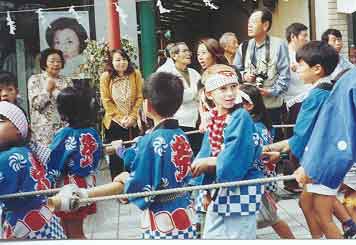 meal of my favorite foods.
(Rich had told
them what I liked). After lunch, the children put on their "happy
coats" to be in the parade. Unexpectedly, our hostess had coats for
both Nick and Allie, but they were reluctant and had to be coaxed into
joining the parade--for just a block. Well, at the end of that block, they
were having so much fun pulling a float, they stayed on to the end of the
parade. I ran through two and a half rolls of film.
meal of my favorite foods.
(Rich had told
them what I liked). After lunch, the children put on their "happy
coats" to be in the parade. Unexpectedly, our hostess had coats for
both Nick and Allie, but they were reluctant and had to be coaxed into
joining the parade--for just a block. Well, at the end of that block, they
were having so much fun pulling a float, they stayed on to the end of the
parade. I ran through two and a half rolls of film. 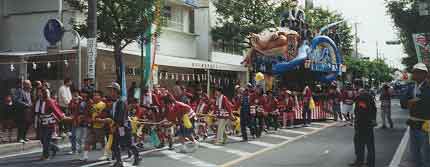 What an experience.